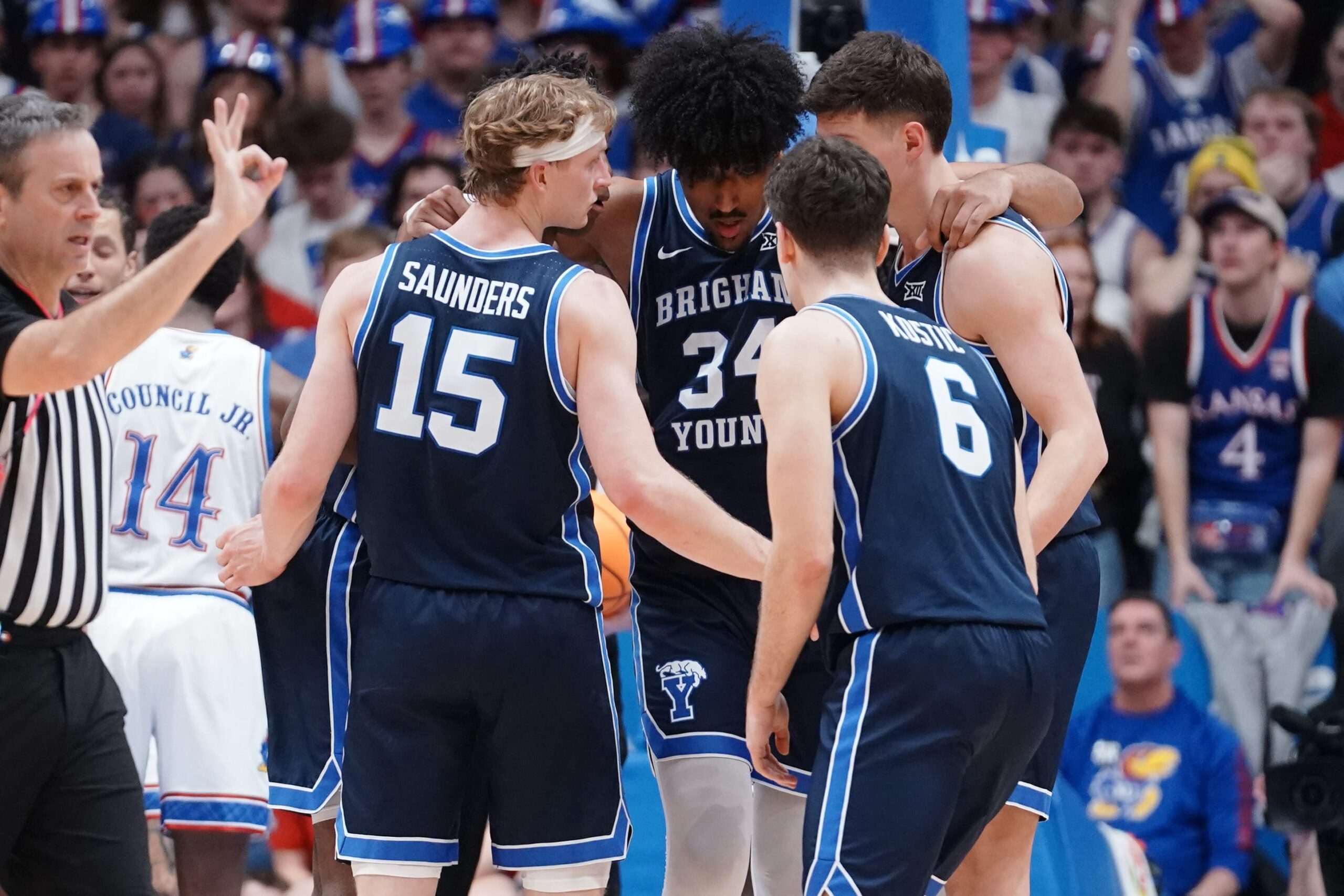
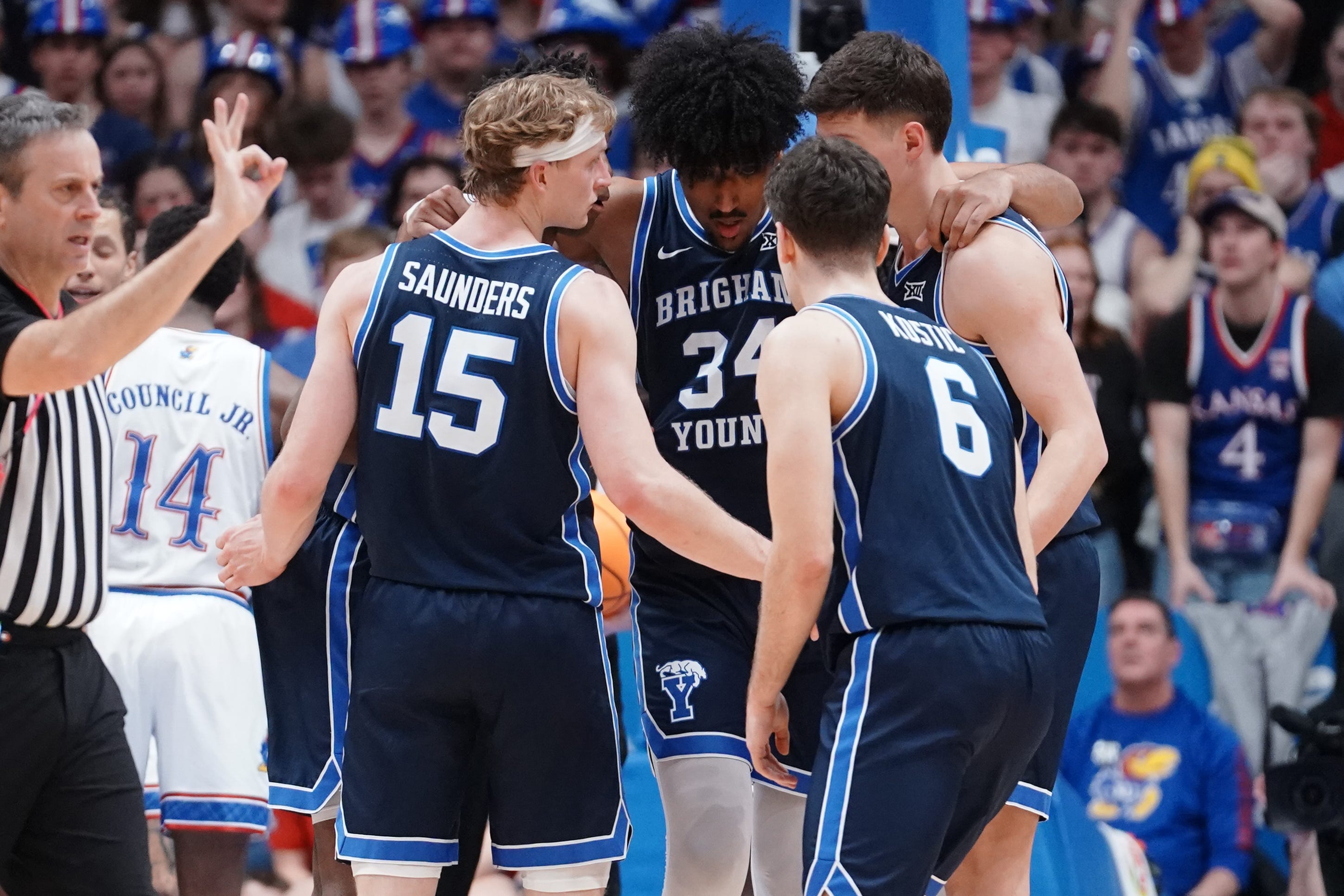
It was a familiar story for BYU Saturday — terrible first half, followed by a complete 180 in the second half that saw BYU nearly complete a 20+ comeback. Ultimately, BYU fell to the Jayhawks and moved to 17-4 on the season.
This week presents another great opportunity (or fall) for BYU with two Quad 1 games. BYU hits the road for a Quad 1 game at Oklahoma State, who is on the fringes of the bubble and trying to work their way into the NCAA Tournament. BYU will be favored and its a winnable game for BYU in what should be a fast-paced game, but the Cowboys are a solid team and won’t be a pushover on their home court. After that, BYU welcomes Houston to the Marriott Center. Houston has looked like a Big 12 title contender, and it would be a chance for BYU to pick up a nice signature win. Two wins and BYU and the fanbase are suddenly feeling great. A split and you keep that mixed feeling. Two losses, and things will turn for the worse.
I have lots of thoughts, but below are three things to think about.
- BYU is a good team, but not great (yet). BYU has beat all the good teams they have played, but lost to all the very good or great ones. BYU is 17-0 in games they are favored and 0-4 when they are an underdog. There is some good wins amongst those 17. Villanova, Wisconsin, Miami, and Clemson are all Quad 1 wins away from home and are projected to be NCAA Tournament teams. Those wins in non-conference play gives BYU a solid floor for NCAA Tournament seeding. BYU beat zero at-large teams last season in non-conference play, and going into February BYU has beaten four teams in non-league play who are expected to make the NCAA Tournament. This isn’t last season though and BYU has higher expectations. All four teams BYU lost to are great and BYU had stretches where they looked like the better team, but ultimately BYU couldn’t put together a full 40 — or even 30 — minutes and ultimately lost. Bottom line is BYU needs Quad 1A wins if they want to solidify a top 3 or 4 seed in the NCAA Tournament. BYU has shown they can be an elite team, but until they start with the same urgency and execution from the opening tip it will be difficult to win those top tier games.
- BYU has quietly become the best rebounding team in the Big 12. The quietest improvement BYU has had in conference play is rebounding. And if you’re looking for a statistical reason for why BYU can go to the next level, rebounding is one of those stats. One of the biggest concerns I heard from fans was BYU’s rebounding ability against big teams. UConn, Clemson, and others had success on the glass versus BYU. Since Abdullah Ahmed joined BYU right before Big 12 team, BYU has been one of the best rebounding teams in Big 12 play. In league play, BYU’s offensive rebound percentage is 37.6% (#1 in the Big 12 play) and opponents offensive rebound percentage is 26.8% (#3 in Big 12 play). That means BYU is rebounding more than 11% of its misses more than opponents, which is the largest gap in the Big 12. The addition of Abdullah Ahmed is a big reason for that. With him as the backup five, BYU always has a great rebounder at the five spot in either Keba or Bido. Even against Arizona’s big front line, BYU had a better offensive and defensive rebounding percentage than the Wildcats. Rebounding is something that typically travels and is more consistent than shooting. If BYU can keep up its rebounding prowess and improve shooting, consistency, and execution, then this team can be the Final Four caliber team we are looking for.
- BYU needs more from the three-point line on both ends of the floor. Three-point shooting has been arguably the biggest thing holding the offense from being elite in Big 12 play. BYU is getting to the foul line and is top 3 in Big 12 play in 2-point percentage, but BYU’s 33.5% three-point shooting in Big 12 play is #11 in the league. The three ball nearly led BYU all the way back in the second half versus Arizona and Kansas, but the porous shooting was one of the factors for BYU’s big hole in both games. In games BYU has won, the three-point shooting hasn’t been good enough for BYU to blow teams out. Richie Saunders is shooting 38.5% from three in Big 12, and if I’m gonna be nitpicky BYU needs a bit more consistency from him. The bigger issue is the other guys. Rob Wright has improved his shooting, but BYU really needs Kennard Davis to hit shots. When he makes shots, BYU’s spacing is so much better and it opens up lanes for AJ and Rob Wright. Asking Kostic to make shots game to game seems like to tall of an ask from him. Asking Kennard to improve his shooting is putting a lot on one person, but that’s kind of where BYU is at. BYU doesn’t need him to be Richie, but the greater threat of Moo hitting shots opens up the offense and improves the spacing, something that KY consistently harps on. Defensively, BYU’s three-point defense was among the Big 12’s best through four games. That has regressed three of the past four games. Arizona shot just 4-12 versus BYU, but Texas Tech (38%), Utah (62%), and Kansas (50%) all shot great versus the Cougs. Even with all of that, BYU allows opponents to shoot 35.2% from three in conference play (#6 in Big 12). BYU has shown it can defend the three ball, now they need to shore up deficiencies from the last few games.