Introduction
Now that the deadline for players to withdraw from the NBA Draft and return to college has passed (you made us sweat it out, Jeremy Fears, but thank you for returning), we thought it might be interesting to compare roster retention and turnover among Big Ten men’s basketball teams. We’re going to look at how much production each Big Ten team is returning from last season, what they lost, and how they are replacing what they lost.
Join the conversation!
Sign up for a user account and get:
- Improved notifications system!
- Fewer ads
- Create community posts
- Comment on articles, community posts
- Rec comments, community posts
A little bit of explanation might be helpful before we get to the charts. For 2026-27 rosters players were categorized as:
- Retained: players on a team in 2025-26 and are returning to the same team for 2026-27.
- Lost to Transfer Portal: players who entered the transfer portal after the 2025-26 season and have either committed to another team or remain in the portal as of this writing. An example is Michigan State to LSU transfer Divine Ugochukwu.
- Lost to NBA Draft: players who declared for the 2026 NBA Draft while they still had college eligibility and, unlike Fears, did not withdraw from the draft prior to the May 27 deadline. Examples include Illinois’ Keaton Wagler, Michigan’s Morez Johnson, and Washington’s Hannes Steinbach. They could have returned to college but have chosen to end their college careers and remain in the draft.
- Lost to Eligibility: players who have used up all of their college eligibility and haven’t been granted a waiver as of this writing. Some of these players, such as Michigan’s Yaxel Lendeborg, will surely be selected in the upcoming NBA draft but they are categorized here and not as ‘Lost to NBA Draft’ because they have exhausted their college eligibility.
Players who will begin their first season with a team in 2026-27 were categorized as:
- HS Recruits: the traditional way to make it to college basketball, by getting recruited out of high school and starting college ball as a 17 or 18-year old. Examples include Michigan State’s Jasiah Jervis, Ethan Taylor, Julius Avent, and Carlos Medlock Jr.
- Transfers In: what you’d expect – a player who transferred from one school in 2025-26 to another for 2026-27. MSU’s Anton Bonke.
- International In: while these players are in their first year of American college basketball, they were not categorized as ‘HS Recruits’. Wisconsin is leading the Big Ten in this category by bringing three players from overseas. One of them, Jackson Ball, has played on New Zealand’s senior national team while another, Owen Foxwell, is a 23-year old Australian who has played five seasons in a professional league. These are not typical ‘high school’ recruits.
Some additional notes on how data was gathered:
- Transfer data was primarily taken from the On3 website but Google searches yielded some transfers that weren’t shown on On3.
- Team rosters on official athletic department websites were analyzed to try to determine remaining eligibility. If unclear, additional searching was done to try to determine if a player on a 2025-26 roster was returning for 2026-27.
- Some players, such as Iowa’s Tavion Banks, are pursuing waivers from the NCAA for an additional year of eligibility while, in some cases, also entering the transfer portal. In Banks’ case, he’s stated he would return to Iowa if granted another year but, for this article, these players have been categorized as ‘out of college eligibility’ and not returning. They have not been categorized as ‘Lost to Transfer Portal’.
- This article could have come out a lot faster if there were still only ten Big Ten teams and there is no way we are ever going to do this for football.
The First Chart
This chart shows what each team is bringing back and what they’ve lost, in minutes played, from the 2025-26 season. Points scored or some other metric could have been used here but we went with minutes. Stats were easy to find using espn.com and minutes played can account for a player’s contributions beyond just scoring.
For example, Michigan State’s Jordan Scott averaged just under six points per game last year but played in all 35 games for the Spartans while working his way into the starting lineup and averaging nearly 21 minutes per game.

In the above chart, teams are sorted by how many minutes they are returning from last season. Minnesota and Michigan State are building on a foundation by returning over 60% of last season’s minutes. Illinois, Iowa, and Rutgers also bring back over half of their minutes played in 2025-26.
It’s interesting to note that, except for Rutgers, these teams were not bitten too hard by the transfer portal. The Spartans lost Ugochukwu, who did start some games last season but, after a season-ending injury at Minnesota, only ended up playing 355 minutes, or 5% of MSU’s total from 2025-26.
Michigan State’s key losses were to eligibility. Carson Cooper and Jaxon Kohler’s combined 1900 minutes (27% of the Spartans’ total from last season) are gone as are Trey Fort, Denham Wojcik, and Nick Sanders who combined for about 7% of the Spartans’ total minutes last year.
On the other end, Indiana is practically starting over with only 7% of their minutes coming back while Penn State and Oregon only bring back 12.5% of their game experience from last year.
Indiana lost nearly 80% of last season’s minutes to eligibility while Penn State, Oregon, and Northwestern saw a mass exodus to the transfer portal.
Only a few teams saw players leave early for the NBA but, obviously, these are major contributors gone from last year’s teams. As noted above, Illinois lost Wagler and Steinbach is not returning to Washington. In addition to Johnson, Aday Mara remained in the draft and will not return to help the Wolverines defend their national title.
Before we move on to the next chart, it should be noted that Michigan’s LJ Cason, who played nearly 7% of Michigan’s total minutes last year doesn’t really fall into any of the categories for this article. He suffered a torn ACL toward the end of last season and, although he is returning to the Michigan team, will be redshirting in 2026-27 as he rehabs the ACL. Because he won’t see the floor this season, Cason was not included in Michigan’s returning minutes.
The Second Chart
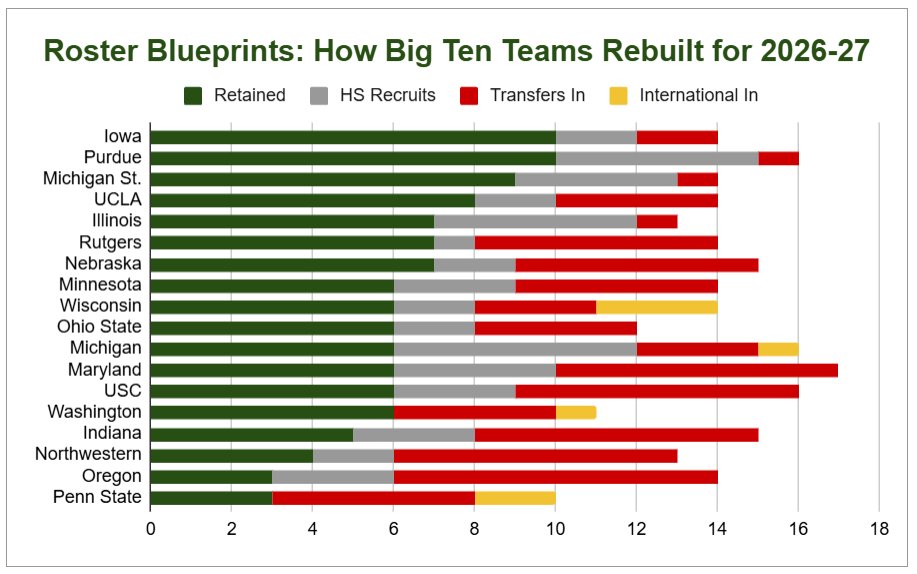
Instead of minutes, this chart looks at how many players return from last year and then how lost players were replaced – either with high school recruits, transfers, or international players.

Here, teams are sorted by the number of returning players from last season. Iowa and Purdue lead the way with 10 players coming back but this is a bit deceptive for Purdue. The 10 players represent just over 40% of the Boilermakers’ minutes from 2025-26 and Purdue is going to have to overcome major losses to eligibility, including Braden Smith, Trey Kaufman-Renn, Fletcher Loyer, and Oscar Cluff.
Michigan State returns nine players while bringing in four high school recruits and a transfer primarily to replace Cooper and Kohler’s minutes.
Indiana returns five players but this represents less than 7% of the Hoosiers’ total minutes from last year. It will likely be an entirely new team on the floor in Bloomington this season as Indiana brings in three four-star high school recruits and a highly-rated seven man transfer class headlined by former Alabama big man Aidan Sherrell.
Northwestern, Oregon, and Penn State will also feature mostly new faces this year and are basically starting over.
It will be interesting to see how much the contingent of international players grows in the Big Ten in coming years. While teams like Purdue and Michigan State continue to rely heavily on traditional high school recruiting classes to supplement their returning cores, Penn State and Wisconsin are looking to older international talent, perhaps in hopes of a quicker rebuild.
One last thing to look at here is the total roster size. College basketball used to have a cap of 13 scholarship players and then teams could add to that with non-scholarship walk-on players. After the House v. NCAA court settlement, the NCAA imposed a hard roster cap of 15 players for men’s basketball, all of which could be on scholarship.
The above chart shows teams above the 15 player limit and there are a few reasons for this. We did the best we could trying to track all of this player movement but there is certainly the possibility of a mistake. For example, a player that is actually out of eligibility may have been counted as a returner.
Hopefully, however, the more likely explanations involve the “Designated Student-Athlete” (DSA) grandfather clause or “pre-season cuts”.
The DSA is a loophole for players who were already on a Division 1 roster before the House settlement. DSA’s do not count against the roster limit. Additionally coaches may carry 16 or 17 players through the spring and summer but then trim that down to the limit of 15 by redshirting extra players.
Conversely, several teams are under the 15 player limit going into the summer, some significantly so. Michigan State sits at 14 and could still add one more player before the season begins. Penn State, however, sits at just 10 players and probably continues to look to whoever is left in the transfer portal, or overseas, to fill their remaining spots.
Conclusion: The New Normal in the Big Ten
When we look at the conference as a whole, the scale of player movement is a staggering reality of the transfer portal. Across the 18 teams, 89 players entered the transfer portal, while only 69 exhausted their college eligibility.
To fill the empty spots, Big Ten coaches brought in 81 transfers compared to just 49 traditional high school recruits. This reinforces a point that has already been made: in the modern era of college athletics, experience is valued over potential. Why spend two years developing a 17-year-old freshman when you can purchase a 22-year-old finished product out of the portal or from overseas?
The result is a conference stripped of continuity. On average, Big Ten teams are returning just 35.3% of their minutes from last season. By comparison, MSU will bring back 60.5%. When the 2026-27 season begins, in addition to still figuring out an 18-team coast-to-coast conference footprint, fans of some schools will be trying to learn the names of the entirely new rosters taking the floor.
Last season, we had to endure watching Michigan’s portalized roster win the national championship. Will it be Indiana that wins the portal lottery this time? Will Wisconsin’s international contingent lead to a Badger breakthrough? Or can we look forward to Michigan State’s traditional approach leading to the Spartans cutting down the nets in Detroit?
It’s never too early to think about! What do you think, TOC?